

PRAYING THE BIBLICAL ROSARY
WITH YOUR CHILDREN
(With separate reflection for parents/grandparents. Published as an e-book, which will incrementally roll out the Mysteries of the Rosary. PDF available at the bottom of this page)
Meditations by Margit McCarthy
Illustrator: Breanna Silvia
With a Bible in one hand and rosary beads in the other, prepare to experience meaningful moments of prayer with your children. The Biblical Rosary is a wonderful family prayer tool that uses scripture and reflects on the life of Christ. Establishing the habit of family prayer yields blessings for all family members, which brim over to touch many lives beyond your family circles. It’s a portal of divine grace. Any adult who commits to praying with children discovers that children have an innate ability to engage spiritual motifs and respond with passion. It can be labeled as a spiritual superpower. That’s why Jesus beckons, “Let the children come to me, and do not hinder them, for the kingdom of heaven belongs to such as these.” (Mt 19:14)
The Third Joyful Mystery: The Nativity
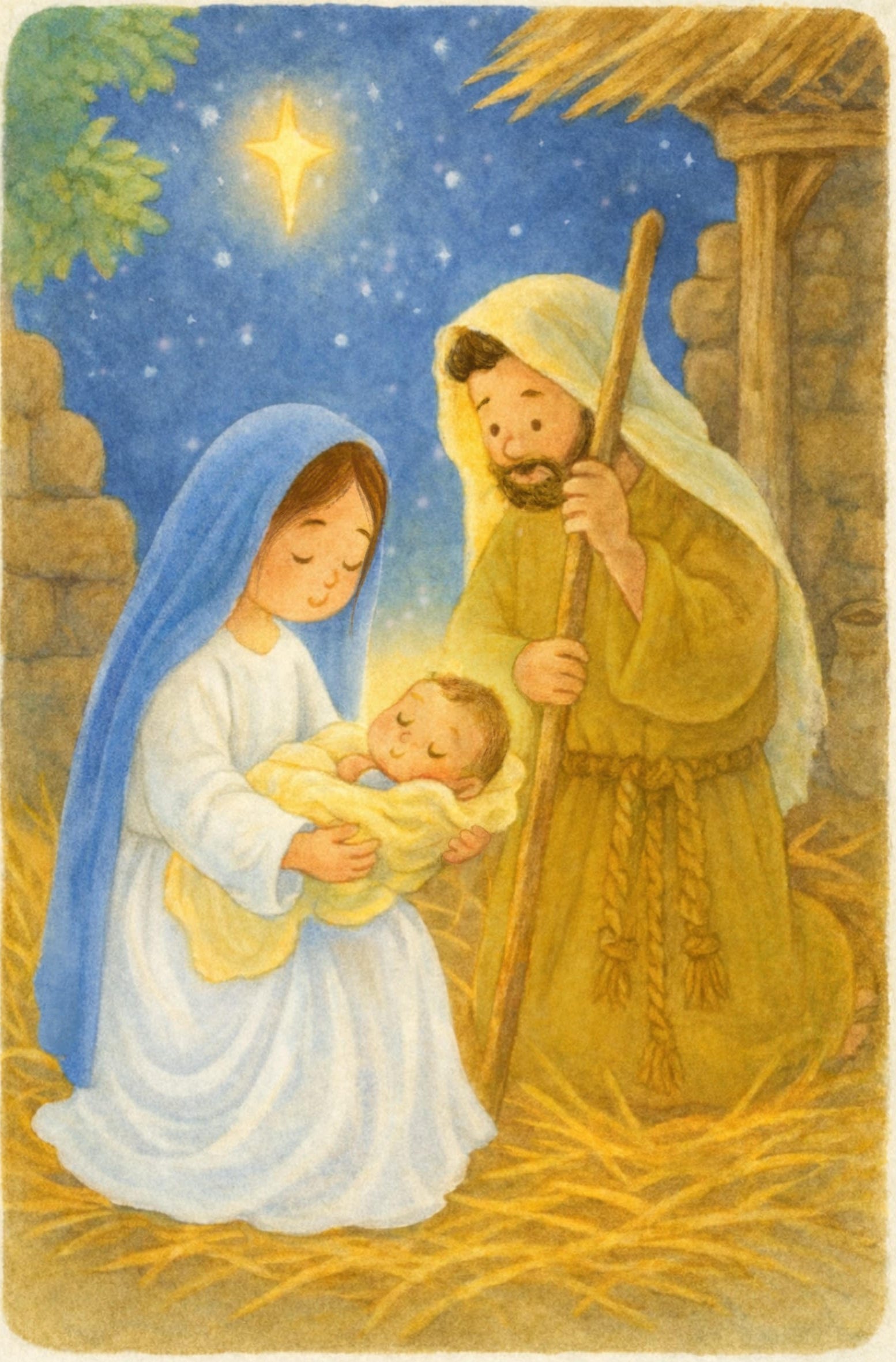
Third Joyful Mystery: The Nativity
Glory to God in the Highest. (Luke 2:14a)
In those days, a decree went out from Caesar Augustus that the whole world should be enrolled. This was the first enrollment, when Quirinius was governor of Syria. So all went to be enrolled, each to his own town. And Joseph too went up from Galilee from the town of Nazareth to Judea, to the city of David that is called Bethlehem, because he was of the house and family of David, to be enrolled with Mary, his betrothed, who was with child. While they were there, the time came for her to have her child, and she gave birth to her firstborn son. She wrapped him in swaddling clothes and laid him in a manger, because there was no room for them in the inn.
Now there were shepherds in that region living in the fields and keeping the night watch over their flock. The angel of the Lord appeared to them and the glory of the Lord shone around them, and they were struck with great fear. The angel said to them, “Do not be afraid; for behold, I proclaim to you good news of great joy that will be for all the people. For today in the city of David a savior has been born for you who is Messiah and Lord. And this will be a sign for you: you will find an infant wrapped in swaddling clothes and lying in a manger,” And suddenly there was a multitude of the heavenly host with the angel, praising God and saying: “Glory to God in the highest and on earth peace to those on whom his favor rests.”
When the angels went away from them to heaven, the shepherds said to one another, “Let us go, then, to Bethlehem to see this thing that has taken place, which the Lord has made known to us.” So they went in haste and found Mary and Joseph, and the infant lying in the manger. When they saw this, they made known the message that had been told them about this child. All who heard it were amazed by what had been told them by the shepherds. And Mary kept all these things, reflecting on them in her heart. Then the shepherds returned, glorifying and praising God for all they had heard and seen, just as it had been told to them. Luke 2:1-20 (NABRE)
Children’s Reflection: Joseph and Mary lived in Nazareth, a small town in Israel. The Roman emperor, Caesar Augustus, could rule many nations, including Israel, because Rome had a strong army. Augustus required these nations to pay heavy taxes so that Rome could gain wealth and maintain their army. He ordered a census to count the number of men who lived in these nations. Joseph was of the family of King David; therefore, he had to travel to Bethlehem, the city where David was born. Joseph and Mary traveled slowly since it was soon time for her to give birth. When they arrived at Bethlehem, there wasn’t any room left in the inn. The city was filled with people because of the census. Joseph wouldn’t give up. Mary needed a place to stay because she would soon give birth. All that he could find was a stable where animals slept. He took Mary there.
He made a bed for her out of hay. The stable was humble yet warm. The animals were happy to have them stay. They sensed the holiness of the moment and kept quiet. There, Mary gave birth to Jesus. Jesus didn’t have a nice crib, but Joseph made a bed for him, too. He used the manger, a wooden trough that animals ate from. He cleaned it for Jesus. Mary wrapped Jesus in the clothes she brought for him. She laid him in the manger. For God so loved the world that he gave his only Son. That place was filled with immense holiness and love.
A baby is always a blessing from God. The people who care for you understand what this meant for Joseph and Mary. When you were a baby, you too were wrapped in clothes and laid in a warm place to sleep. There probably weren’t any barn animals where you slept, yet maybe you would have liked that? Your room was also filled with love.
Prayer: DDer Jesus, you were once a baby just like I used to be. Angels also sang praises to God when I was born because of your great love for me. Help me to love you too and follow your plan for my life. Goodness and holiness are found in you.
The Lord’s Prayer
Ten Hail Mary’s
The Glory Be
O my Jesus, forgive us our sins, save us from the fires of hell, lead all souls to Heaven, especially those in most need of thy mercy.
Parents’ Reflection:
Both Matthew and Luke record Our Lord’s Nativity. Their distinct narratives present a harmonic proclamation of His Divine identity and fulfillment of numerous Old Testament prophecies. Convergence centers on His miraculous conception; Mary’s perpetual virginity; Davidic lineage through Joseph’s guardianship; birth in Bethlehem; angelic manifestations; and universal scope of mission signaled by Roman involvement, the Magi’s quest, Judean settings, and lowly Jewish shepherds. Many people sentimentalize the Christmas story, yet closer examination reveals difficult realities. Traveling when Mary was near her due date exposed them to numerous dangers. It emphasized the raw fact that Judea was an occupied nation, her people heavily taxed and oppressed by foreign powers.
It is precisely in this oppressive environment that Jesus chose to be born. Consider the shocking poverty which He freely embraced: subjected to a census which counted people like cattle, traversing rugged terrain, no room for them in the inn, born where oxen, sheep, and donkeys lodged. Mary and Joseph adapted to all these hardships yet remained perplexed. Most likely, they felt woefully inadequate to care for the Son of God. Didn’t Jesus deserve much better?
Christ’s radical solidarity with the plight of Fallen Man had an immediate impact on His family’s lives. We view the Crucifixion as His suffering moment. It is the consummation of a life dedicated to perpetual self-giving love. Contemplate that His entire earthly journey was stamped with cruciformity. Mary and Joseph shared in His walk and matured in God’s ways. They also learned a lot about parenting. Difficult moments twine with the joy and blessings of family life. All parents face numerous challenges. Difficulties open new opportunities to cling to Jesus, who committed Himself to solidarity with each one of us. Everlasting beauty is carved at the expense of the willingness to imitate Christ and let Jesus teach us the ways of authentic love.
Jesus promised to never leave us nor forsake us. Gospel Nativity narratives radiate the spiritual reality of His Abiding Presence available at every moment.
Mary kept all these things, reflecting on them in her heart
